We must admit something at the outset, and on this there should be no division among us: **Murugan is a war lord.**
Grant that, and a question follows immediately. A commander needs transport. What did he ride into battle?
✎ Koomaren◷ 30 July 2026
# Annan: The War Elephant Murugan Named After His Brother
## First, let us admit it
We must admit something at the outset, and on this there should be no division among us: **Murugan is a war lord.** Not only the beautiful youth on the bird. Not only the lover of Valli, not only the child who charms. A commander. A god who took the field.
The Tamil tradition has never been shy about this. The **Vel** in his hand is not an ornament. He is the one who broke **Sūr**, and Sangam poetry credits him with that destruction without apology or hedging. From the earliest lines Tamils wrote about their gods, Murugan stands over the hill country as its defender — and the land of the Tamils has been under his protection for as long as Tamils have recorded what they believe. Across the Palk Strait, across the Indian Ocean, wherever Tamils carried themselves and their fire, they carried a war god with them, because a people who must protect what they have does not choose a passive deity.
Grant that, and a question follows immediately. A commander needs transport. What did he ride into battle?
Ask anyone which animal carries Murugan and the answer comes quickly: the peacock. Paravani, blue-necked and blazing, is the image printed on calendars, moulded into temple chariots, tattooed on the shoulders of young devotees. But the peacock is not the whole story — and in war, as we shall see, the peacock was doing something other than carrying.
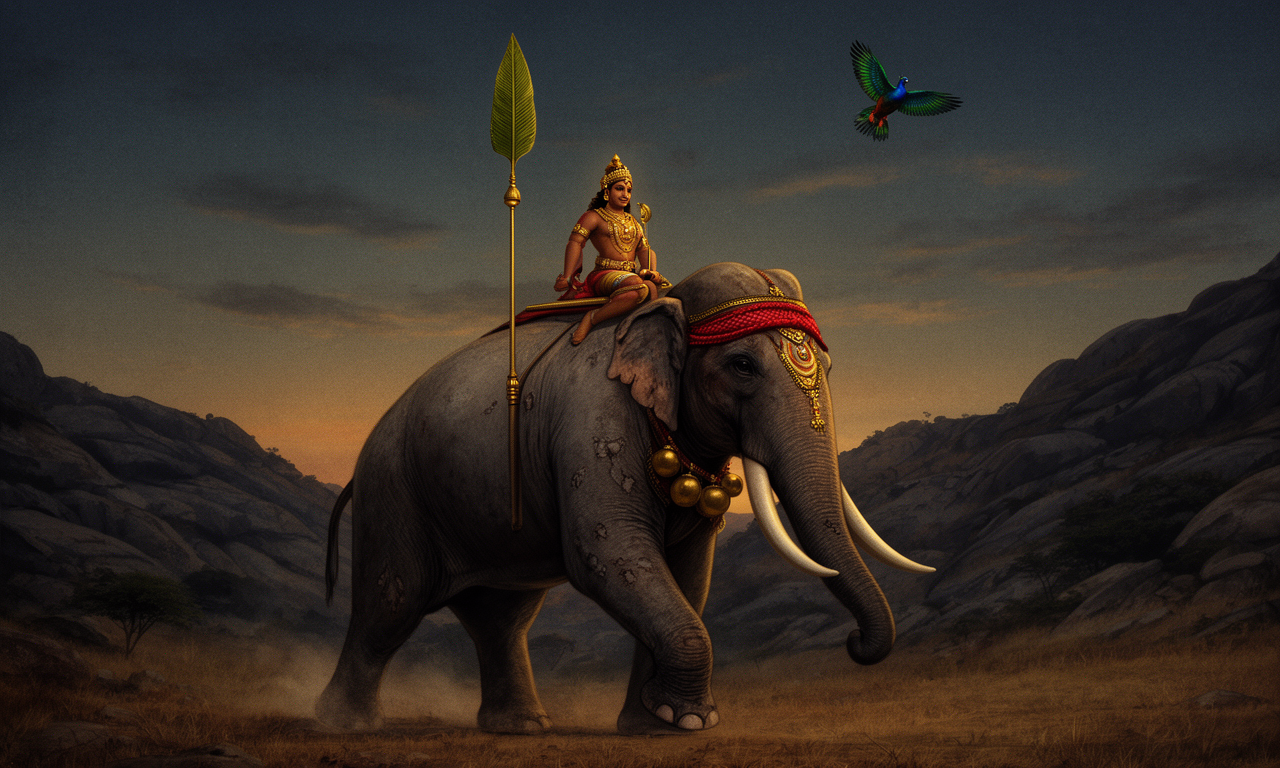
When Murugan rode out to *fight*, he rode an elephant. And according to a tradition kept alive in the mouths of devotees rather than on the page, he did not call it by any formal name. He called it **Annan**. Elder brother.
## The elephant stands on Tamil ground
Before coming to the name, the elephant itself has to be established — and it can be established without leaving Tamil soil.
Nakkeerar's **Thirumurugatruppadai**, the foundational Tamil poem on Murugan and the oldest sustained portrait we have of him, knows the elephant mount. So do the Sangam anthologies — *Pathitrupathu*, *Akananuru*, *Purananuru* — where the god of the hill country is bound up with the great tusker as naturally as with the spear.
Centuries later, Arunagirinathar's **Thiruppugazh** returns to the image again and again: Murugan seated on a rutting elephant, the *sindura kaliru*, praised for the sweep of its tusks and the sheer weight of its strength. Arunagirinathar was not reaching for an exotic detail. He was singing something his listeners already saw in their temples.
The mount carries a name in Tamil usage — **Pinimukham** — and it carries a specific function: war, and the moments when the god comes in full sovereignty to bless.
The stone agrees. Chola-period sculpture gives us *Gajavahana*, Murugan mounted on the elephant, and medieval inscriptions — including those recorded around Villupuram — put the iconography on the historical record rather than leaving it to legend.
And it survives in living worship, which is the strongest evidence of all. At **Thiruparankundram**, first of the six sacred abodes, the elephant is the vahana. At **Thiruthani** it remains the primary mount. Chidambaram, Vellore, Piranmalai, Chettikulam and the Sangameswarar temple at Coimbatore all keep the elephant rather than the bird. The peacock never replaced the elephant. The two divided the work between them — and the division is a military one.
## The peacock was the éclaireur
Here is where devotion and common sense meet, and where the peacock stops being merely beautiful.
No commander rides his heaviest animal into unknown ground. Before the army moves, something must go ahead — something fast, something that climbs, something that sees. In military language the French word is exact and has no clean English equivalent: **éclaireur**. The scout. Literally, the one who brings light to the ground ahead.
That is the peacock's wartime office.
Consider what the animal actually is in the Tamil landscape. It belongs to the hills and the scrub, the same *kurinji* country Murugan governs. It rises. It covers distance the tusker cannot. It has extraordinary eyesight and an alarm call that carries across a valley. And it walks without fear into terrain where serpents lie, because the serpent is its natural prey — which is to say, the peacock enters hostile ground as a matter of habit, not of courage summoned.
Set that against the elephant. The elephant does not scout. The elephant *arrives*. It is the mass at the centre of the line, the thing that breaks a formation by existing, the platform from which a commander is seen by his own troops and dreaded by the enemy's.
So the two mounts are not rivals and never were. They are two arms of one campaign:
- **Paravani, the peacock** — reconnaissance. Altitude, speed, sight. It goes forward, reads the ground, finds the enemy's position, and returns with what the commander needs before a single spear is thrown. Intelligence. - **Annan, the elephant** — the assault. Weight, presence, endurance. It moves when the decision has already been made. Force.
The peacock finds the war. The elephant fights it.
And note how neatly this sits with the rest of Murugan's character. The Vel is a thrown weapon — it needs a target, and a target needs to have been located first. The god who kills at distance is precisely the god who would keep a scout. Tamil military imagination did not hand him two animals out of abundance. It handed him a reconnaissance wing and a heavy division.
This also explains why the peacock dominates the popular image while the elephant holds the older temples. The peacock is the god in motion — searching, arriving, blessing, courting. That is most of what a god does, most of the time. The elephant is the god on the day of battle. Rarer, heavier, and therefore kept in the sanctum rather than on the calendar.
## Why "Annan"
Now the name itself — and it can be read on Tamil ground alone, without importing anything.
Start with what the word does in Tamil. **Annan** is not a title and not a liturgical term. It is ordinary kinship: what a younger brother says, in a house, out loud. But it does a second thing, and every Tamil knows it. Between fighting men, between men who work dangerous ground together, *annan* is what you call the older one — the one who went in before you, who knows the terrain, whose judgment you defer to. It is the soldier's word for a senior comrade. It carries respect without hierarchy, seniority without command.
That is a complete reading of the name, and it needs no theology at all.
An elephant is not a horse. A horse is directed; an elephant is *consulted*. It has its own footing, its own reading of ground, its own memory of a road it has walked before. A commander on an elephant's neck is not sitting on equipment. He is sitting on the shoulders of something older and heavier than himself, whose judgment about where a foot can safely land is better than his own.
So the war god does not name his mount for a beast. He gives it the word a soldier gives the veteran beside him. **Annan.** Elder comrade. The one who goes in first.
There is a second layer, and it should be dated honestly rather than smuggled in. In the medieval devotional revival — not in the Sangam corpus — Arunagirinathar addresses Murugan in Thiruppugazh as *karikkum ilaiyone*, the one younger than the elephant-faced Lord. That is a Tamil poet writing in Tamil in the fifteenth century, and for readers who hold to that later layer, the name gathers a family meaning on top of the military one. Readers who work strictly from the Sangam corpus will note that the elephant-faced brother is simply absent from it, and may leave the second layer aside. The first reading stands either way.
As devotees tell it: on the eve of the campaign against Sūr, the peacock had already gone ahead and come back. The ground was known, the enemy located. Then the god mounted the great elephant.
And looking down at the grey head and the curved tusks, he found he could not address the animal as a beast of burden. It had gone into worse ground than this before he was born.
So he called it **Annan**, and rode to war on the word.
## What the name is doing
Read plainly, the story makes a theological point more economically than any doctrine states it.
A war god riding an animal named "elder comrade" is a war god publicly admitting he does not go alone. The Vel in his hand is his own; the ground beneath him is borrowed. Valour is the young virtue — quick, bright, willing. Judgment is the old one, and judgment is what carries valour to the place where it can be spent. From the peacock's first flight to the elephant's charge, the whole campaign is a sequence of things done *for* the god before he strikes. He supplies the spear. Others supply the ground.
**Saiva Siddhanta** reads the two mounts as a matched pair, and the reading fits precisely here. The peacock stands for *anava*, the ego — born with the soul, never destroyed, only mastered, which is why Murugan sits squarely on top of it. The elephant stands for *kanma*, karma — vast, patient, accumulated, and likewise subdued by being ridden rather than killed. On the peacock he governs his pride. On Annan he governs the weight of deeds. Neither animal is defeated; both are ruled. A commander does not destroy his own assets. He rides them.
And there is a quieter meaning still. To give a war elephant the word *annan* is to insist that the fiercest thing a god does is not done among instruments. It is done among companions, in a language of respect that a Tamil household and a Tamil war-band share.
## The word in the mouths of fighting men
If the reading above is right — that *annan* is the soldier's word for a senior comrade rather than a word of command — then it should be visible wherever Tamils have organised themselves for war, not only in temples. It is. And the best-documented case is also the most recent, close enough to be checked against the testimony of people still living.
Begin with the lexicon. V. Visvanatha Pillai's Tamil–English dictionary records for the related honorific *annal* a spread of meanings that includes elder brother, a superior, a great man, and greatness or dignity itself. The word family sits astride kinship and eminence: it can name your brother and it can name a lord, and Tamil does not feel the need to choose. Kambar uses *annal* of Rama in the twelfth century — *annalum nokkinaal; avalum nokkinaal* — where it carries stature without any suggestion of rank held over the person addressed.
Now the modern case. In the Sri Lankan Tamil militant movement, forms of address shifted over two decades in a way that is unusually well recorded. Velupillai Prabhakaran was known in the early 1980s as *Thambi* — younger brother. By the early 1990s junior cadres addressed him as *Annai*. A *Time* correspondent, Edward Desmond, reported in September 1991 that his followers used that word for him, and recounted government soldiers' account of a mortally wounded cadre captured at Elephant Pass whose last words called not for her mother but for "Annai." By the early 2000s, in wider Tamil public usage, he had become *Thalaivar* — the leader.
Three words, one man, three relationships. And the sequence is the evidence.
**Note which word arrived when he became a commander in the public eye.** Not *annan*. *Thalaivar*. Tamil had a word available for the man who gives orders, and it reached for that word instead. *Annan* was what he was called by those who worked beside him; *thalaivar* was what he was called by those who were led.
The decisive detail runs the other way, and it is the one that settles the question. Anton Balasingham — older than Prabhakaran, the movement's theoretician and its negotiator — was known universally as **Bala Annai**, and he was known that way *because Prabhakaran addressed him so*. The man who held command gave the elder's word to a man he did not obey. That is *annan* doing precisely the work this article claims for it: marking seniority, experience and deference of judgment, while leaving the question of command entirely untouched.
A commander can call another man *annan* without ceasing to command. A god can call an elephant *annan* without ceasing to be the lord of the place. The word was never about who is in charge. It is about who has been there longer and knows the ground.
*A necessary note on this example.* It is offered as linguistic evidence and nothing else. The Liberation Tigers of Tamil Eelam was a proscribed organisation in numerous jurisdictions; its record includes assassinations, suicide bombings and the recruitment of children, and the war in which it fought remains among the most bitterly contested subjects in Tamil public life, with profound disagreement over responsibility and atrocity on all sides. Citing how a word was used in that movement is not an endorsement of the movement, and readers who take a different view of that history can accept the point about *annan* without accepting anything else.
## The order of the fortress
There is a further argument to be made, and it is made in stone rather than in verse. It concerns *where things are placed*.
At the **Arupadai Veedu**, the six abodes, Murugan holds the sanctum. This sounds obvious and is not. Across the Tamil country he appears constantly as a subsidiary shrine in someone else's temple — a side chapel in a great Saiva complex, a secondary deity in a courtyard. At the six abodes he is not a guest. The centre is his. At Thiruparankundram, the first of them, the main shrine is cut into the living rock of the hill with the god carved into its face, and everything else in that rock is arranged around him.
That rock does contain other cells. Shiva, Vishnu, Durga and Vinayaka are all present in the cave at Thiruparankundram. Accuracy requires saying so. But note the exact relation: **present, not presiding.** They flank. The sanctum is not shared, and it is not theirs.
Whether those flanking figures are contemporary with the earliest excavation is a separate question, and an open one. The site was not made in a single campaign: an early Pandya rock-cut phase was extended by later Pandya work, and the Nayakas added mandapams and the great Rajagopuram centuries after that. It is entirely possible that some of the flanking cells or their images belong to a later phase than the god's own, and the suspicion is a reasonable one to hold. It is not, however, something this article can assert. Settling it requires the tools of the discipline — comparative analysis of early Pandyan rock-cut style, iconographic dating of the figures, and above all the temple's own body of some forty-one inscriptions, read for what they record about who endowed what and when. Until someone does that work and publishes it, the honest position is: the relation of centre to periphery is clear, the chronology of the periphery is not.
Now consider the newer temples, where Vinayagar frequently stands at the entrance — first in the devotee's path, met before the god of the place is met. This is commonly read as precedence: whoever is encountered first must be greeted first, therefore ranks first.
Read it as a soldier reads a plan, and the conclusion inverts.
**Where is an elephant stationed?** Not in the throne room. Not in the inner apartments. An elephant is stationed *at the gate*. That is where it is needed and that is where it belongs — because the gate is what an elephant is for. War elephants forced gates; gates across the subcontinent were built massively, spiked and angled specifically against elephants. The animal and the gateway are a single military problem. Where the wall is thinnest, you put the heaviest thing you have.
A position at the gate is therefore not a throne. It is a **post**. The sentry stands at the entrance not because he outranks the king but because that is where the danger enters. To be placed at the threshold is to be given the duty of the threshold — and the duty of the threshold is to hold it while the centre is protected.
Set beside the two mounts, a complete spatial order emerges, and it is a military order all the way through:
| Position | Function | Who holds it | |---|---|---| | **Beyond the walls** | Reconnaissance — see the enemy before he is close | The peacock, the éclaireur | | **At the gate** | Guard and assault — hold the threshold, break the enemy's | The elephant, Annan | | **The centre** | Sovereignty — the one whose land it is | Murugan |
The elephant is kept outside the citadel because the citadel is what the elephant defends. The scout is kept further out still, because sight must reach further than force. And in the middle, in the rock, with the spear, sits the lord of the place.
Read this way, the entrance shrine tells you nothing about rank and everything about **stationing**. The gate belongs to the elephant. The sanctum belongs to Murugan. Nobody has been demoted, and nobody has been promoted. Each is where the defence of the land requires him to stand.
## In the temple, in the street
None of this stayed in the texts. The Cavadee and Thaipusam processions — carried through Mauritian, Réunionnais, Malaysian, Singaporean and Sri Lankan streets as fervently as through Tamil Nadu — are a war god's campaign performed on foot. The devotee who lifts the wooden arch onto pierced shoulders, fasting, walking barefoot on hot tar, is not merely enduring. He is doing what the god did: knowing the road before setting out on it, and carrying weight he cannot carry alone.
And he is never alone. Someone walks ahead of a Cavadee-bearer. Someone watches the road, calls the pace, clears the crowd, catches him if the fast has emptied him out. That companion has a name in Tamil, and it is the name in the title of this article. The scout goes first; the elder one carries. The devotee does not learn this arrangement from a book. He learns it in the street, from the man beside him.
The peacock goes first, because someone must see. Annan carries the weight, because someone must bear it. And the war lord of the Tamils rides between them — protected, as he has protected his land, by not insisting on doing it alone.
---
### A note on sources
This article draws only on Tamil sources and Tamil practice: the Sangam corpus, above all Nakkeerar's Thirumurugatruppadai; Arunagirinathar's Thiruppugazh; Chola-period sculpture and medieval inscriptions; the philosophy of Saiva Siddhanta; and the temples where the elephant vahana is still in service today. No puranic literature is cited or relied upon.
Within that frame, one distinction should be kept honest. Murugan's status as a war god and the slayer of Sūr, the elephant mount and its name Pinimukham, the Tamil ordering of Vinayaka as the elder brother, and the temples that retain the elephant are all attested in the literature, the stone, or current worship. Two things here are interpretation rather than citation: the reading of the peacock as *éclaireur* — a military logic drawn from what the animal is and where it lives, not a line from a text — and the tradition that Murugan named the elephant **Annan**, which is oral and devotional. Both belong to the spoken layer of Kaumara devotion, where the theology of the tradition gets restated as strategy and as family feeling. That layer is not a lesser one. In Tamil worship it is often where the truest things are kept.
---
# Scholarly Apparatus
## Standing in the peer-reviewed literature
An article of this kind should be honest about which of its claims a scholar could check, which are contested, and which belong to the author. Three tiers apply here.
**Tier 1 — corroborated in peer-reviewed scholarship.** Murugan's character as a warrior deity of the *kurinji* hill country, and his identity as the slayer of Sūr, are established in the academic study of Sangam literature. M. Shanmugam Pillai's analysis of Murukan in the Cankam corpus, prepared for the First International Conference Seminar on Skanda-Murukan (Chennai, 1998) and published in the *Journal of the Institute of Asian Studies*, examines the earliest strata of Murukan worship — including the *veriyattu* rites and the structure of Nakkeerar's *Tirumurukarruppatai* — and situates him firmly in the pre-puranic Tamil religious landscape. Fred W. Clothey's *The Many Faces of Murukan* (1978), still the standard reference work in English, traces the deity's development from "Murukan in the early South" onward, and his warrior aspect is central to that account.
**Tier 2 — attested, but with an important qualification.** The elephant mount and the *Gajavahana* iconography are real and documented. But scholars of South Indian iconography treat the **peacock** as the decisive identifying marker: Prof. Raju Kalidos, in his study of Skanda-Murukan iconography (*Journal of the Institute of Asian Studies*, March 1999), identifies ambiguous images specifically by the presence of the *mayil* behind the deity. Readers should therefore understand the elephant as a recognised but secondary vahana form, not a co-equal one in the surviving image record. This article's emphasis on the elephant is an emphasis of *theme*, justified by the war context — not a claim that the elephant outweighs the peacock in the corpus.
The claim about inscriptions in the Villupuram region is reported in Mauritian devotional journalism and has **not** been verified here against a published epigraphical corpus. Anyone wishing to cite it should check the relevant volumes of *South Indian Inscriptions* or the Annual Reports on Indian Epigraphy directly.
**A second correction on record.** A draft of this article proposed that Prabhakaran did not use, or was not addressed by, the term *annan* within his close circle. The documented record does not support this and the passage was rewritten accordingly. Cadres did address him as *Annai* from the early 1990s; the term *Thambi* preceded it and *Thalaivar* followed it in wider public usage; and Anton Balasingham was called *Bala Annai* precisely because Prabhakaran used that form for him. The corrected version is more useful to the article's argument than the original proposal would have been, since it demonstrates the separation of seniority from command directly rather than by inference. Source: Edward Desmond, *Time*, 16 September 1991, p. 20, as reproduced and discussed in the essay "Anna, Annachi, Annathe" (Ilankai Tamil Sangam), which also supplies the lexical material from V. Visvanatha Pillai's Tamil–English dictionary (1951).
**A correction on record.** A draft of this article held that Vinayaka is absent from the interiors of the Arupadai Veedu temples. That is not correct and has been removed. The Pandya-period rock-cut shrine at **Thiruparankundram** contains five cells cut into the Parankundram rock, housing Murugan, Shiva, Vishnu, Vinayaka and Durga; a Pillaiyar shrine (Uchipillaiyar) also stands at the hill's summit. The temple carries some forty-one inscriptions documenting its patronage across several centuries, and any argument about what was originally present versus what was added later must be settled against those inscriptions and the architectural phasing — early Pandya cave, later Pandya expansion, Nayaka mandapams and the Rajagopuram — not by inspection of the temple as it stands today. What the article now claims is narrower and defensible: at the six abodes Murugan holds the sanctum and is not a subsidiary deity in another god's temple, and the other figures in the rock flank rather than preside.
**Tier 3 — interpretation and oral tradition, offered as such.** Three things in this article are not citations and are not presented as citations:
- The reading of the peacock as **éclaireur** is the author's own military reading, drawn from the animal's habitat, speed and behaviour. No text assigns the peacock a reconnaissance role. It is offered as an interpretation that makes sense of why a war god keeps two mounts. - The reading of **annan** as the soldier's address to a senior comrade is an argument from Tamil usage, not from a cited text. The usage itself is ordinary and verifiable in spoken Tamil; its application to the war elephant is the author's. - The **stationing** argument — that a position at a temple entrance signifies a guard post rather than ritual precedence, on the analogy of where a war elephant is stationed in a fortified place — is the author's structural reading. The military premise is sound: elephants were used against gates and gates were fortified against elephants. The transfer of that logic to temple architecture is an interpretation, and a reviewer could reasonably answer that Hindu temple space follows its own iconographic grammar of thresholds and guardian figures rather than a military one. It is offered as an argument to be weighed, not a finding. - The tradition that Murugan named the elephant **Annan** is **oral and devotional**. It does not appear in the Sangam corpus, in Thiruppugazh, or — so far as the published literature shows — in any academic study of Murukan. It belongs to the spoken layer of Kaumara devotion. That layer is not a lesser one; in Tamil worship it is frequently where the tradition's meaning is actually transmitted. But it must not be dressed up as textual.
## On the omission of ritual precedence
Earlier drafts of this article stated that Vinayaka is honoured first at Murugan shrines and that Cavadee processions open with Pillaiyar. Both statements are accurate as **descriptions of present-day practice**, and readers should know that. They have nevertheless been removed, and the reasoning should be on the record rather than left as a silent gap.
The historical ground for the removal is real and is the strongest part of the case: **the Sangam corpus is silent on Ganesha.** The earliest Tamil religious literature — the anthologies, and Nakkeerar's *Tirumurukarruppatai* — knows Murugan as lord of the *kurinji* hills at length and in detail, and does not know an elephant-faced deity at all. Ganapati's establishment in the Tamil country is conventionally dated considerably later, to the Pallava period. On the evidence of the earliest Tamil sources, therefore, Murugan's worship does not require and did not originally include a prior invocation of Vinayaka.
What follows from that, and what does not, should be stated carefully. It follows that ritual precedence cannot be presented as original to Tamil Murugan worship or as intrinsic to it. It does not follow that the practice is absent today — it plainly is not — and an ethnographer describing a Mauritian Cavadee in 2026 would be wrong to omit it.
Beyond that point the question becomes historiographically **contested**, and this article does not adjudicate it. Whether the later precedence represents a Brahmanical or Sanskritic overlay upon an indigenous Dravidian substratum, or a normal internal development of a religion that absorbed and reshaped what it met, is a live disagreement in Tamil historiography with committed scholarship and strong political investment on both sides. Readers should be aware that the choice made here reflects one position in that debate, taken at the author's direction, and that a reviewer holding the other position would object to it.
One further consequence should be admitted plainly. The word *annan* means elder brother, and in the devotional tradition the elder brother in question is the elephant-faced one. Removing him without replacement would leave the article's own title without a referent. The article therefore rests the name primarily on Tamil military usage — *annan* as the address given to a senior comrade — which stands independently of any theology, and treats the fraternal reading as a clearly dated medieval layer deriving from Arunagirinathar's Thiruppugazh. Note that this line, *karikkum ilaiyone*, is Tamil, composed by a Tamil poet in the Tamil devotional tradition; whatever one concludes about ritual precedence, that particular piece of evidence cannot be set aside as foreign.
## Select bibliography — books
- **Clothey, Fred W.** *The Many Faces of Murukaṉ: The History and Meaning of a South Indian God.* With the poem "Prayers to Lord Murukaṉ" by A. K. Ramanujan. The Hague / Paris / New York: Mouton Publishers, 1978. *Religion and Society* No. 6. ISBN 90-279-7632-5. (Reprinted by De Gruyter Mouton, 2019.) — The essential work. Chapters on Murukaṉ in the early South and on the medieval period are directly relevant. - **Clothey, Fred W.** *Quiescence and Passion: The Vision of Arunakiri, Tamil Mystic.* 1996. — For Arunagirinathar and the Thiruppugazh. - **Clothey, Fred W.** *Rhythm and Intent: Ritual Studies from South India.* 1983. - **Zvelebil, Kamil V.** *The Smile of Murugan: On Tamil Literature of South India.* Leiden: E. J. Brill, 1973. xvi + 378 pp. — Foundational for the Tamil literary frame. Zvelebil also produced a dedicated volume titled *Tiru Murugan*. - **Chelliah, J. V.** *Pattuppattu: Ten Tamil Idylls.* Colombo: General Publishers Ltd, 1947. — English translation of the Ten Idylls, including *Tirumurukarruppatai*; the standard route into the primary text for non-Tamil readers. - **Thakur, Upendra.** *On Karttikeya.* Varanasi: Chaukhambha Orientalia, 1981. 114 pp. + 43 plates. - **Chatterjee, Asim Kumar.** *The Cult of Skanda-Karttikeya in Ancient India.*
## Select bibliography — peer-reviewed and conference scholarship
The **First International Conference Seminar on Skanda-Murukan** (Institute of Asian Studies, Chennai, 28–30 December 1998) remains the single most concentrated body of scholarship on this deity; papers appeared in the *Journal of the Institute of Asian Studies*. The series continued, including a Third Murukan Conference hosted by the Department of Indian Studies, University of Malaya, Kuala Lumpur (2003).
- **Shanmugam Pillai, M.** "Murukan in Cankam Literature: Veriyattu Tribal Worship." *Journal of the Institute of Asian Studies*, September 1999. (First International Conference Seminar on Skanda-Murukan, Chennai, 1998.) - **Kalidos, Raju.** "Iconography of Skanda-Murukan: Flashes of Insight." *Journal of the Institute of Asian Studies*, March 1999. (Same conference.) - **Pandurangan, A.** "Historical Development of Murukan as a Tamil Deity." Same conference. — Directly relevant to the claim that Murugan is a Tamil deity first. - **Pathmanathan, S.** "The Hindu-Buddhist Interaction in Sri Lanka: Skanda, a Guardian God of Lanka." Same conference. — For the protective, land-guarding function across the Palk Strait. - **Nilamegame, S.** "Skanda-Murukan Kavati on Réunion Island." Same conference. — Of particular interest for Indian Ocean and Mascarene readers: the nearest scholarly treatment of Kavadi practice in our own region.
**Review record of the principal sources.** Clothey's *Many Faces of Murukan* was reviewed by J. Bruce Long in *The Journal of Asian Studies* 40, no. 3 (May 1981): 625–627. Zvelebil's *Smile of Murugan* was reviewed in the *Bulletin of the School of Oriental and African Studies* (1974). Both passed through the normal apparatus of academic scrutiny and remain in citation.
## For the Thiruparankundram chronology
Anyone wishing to test whether the flanking cells and images at Thiruparankundram post-date the principal excavation should work from the following rather than from site inspection:
- **Soundara Rajan, K. V.** *Rock-cut Temple Styles: Early Pandyan Art and the Ellora Shrines.* Somaiya Publications, 1998. - **Soundararajan, K. V.** "Pandyas of Madurai: Phase I" and "Pandyas of Madurai: Phase II." In Meister, M. W. and M. A. Dhaky (eds), *Encyclopaedia of Indian Temple Architecture*, 1999: 81–86, 111–24. - **Srinivasan, K. R.** *Cave Temples of the Pallavas.* New Delhi: Archaeological Survey of India, 1964. — Comparative method for dating South Indian rock-cut phases. - **Rao, T. A. Gopinatha.** *Elements of Hindu Iconography.* 2 vols., 4 parts. 1914; reprinted Delhi, 1999. — The standard reference for iconographic identification and dating. - **Nilakanta Sastri, K. A.** *The Pandyan Kingdom.* Madras: Swathi Publications, 1972 [1929]. - **Raman, K. V.** *Some Aspects of Pandyan History in the Light of Recent Discoveries.* Sri Subrahmania Ayyar Endowment Lecture, 1971–72. Madras: University of Madras. - The temple's own inscriptions, via *South Indian Inscriptions* and the Annual Reports on Indian Epigraphy.
A note on method. A later *carving* and a later *cult* are not the same finding, and the distinction matters for the argument this article makes. Establishing that an image was cut in a later phase would show when that image entered this temple; it would not by itself establish when the deity entered Tamil religion, nor the reverse. Both questions are answerable, but they need different evidence, and conflating them is the commonest way arguments of this kind fail review.
## Primary Tamil texts
- **Nakkeerar.** *Tirumurukarruppatai.* Available in numerous editions; see *Tirumurukārruppatai Uraikkottu*, Śrī Kasi Madam Publication, Tiruppanantal, 1993. - *Pattuppattu* (the Ten Idylls), *Akananuru*, *Purananuru*, *Pathitrupathu* — Sangam anthologies. - **Arunagirinathar.** *Thiruppugazh.* See also *Panniru Tirumuraikal (Mulamum Telivuraiyum)*, Vartamanan Patippakam, Madras, 1998.
## Statement on review status
This article has **not** been peer reviewed. It is a work of interpretive cultural writing that rests on peer-reviewed scholarship without itself having been submitted to it. Readers should treat Tier 1 material as reliable, Tier 2 material as reliable with the stated qualification, and Tier 3 material as the author's reading and the community's oral inheritance.
**A note on the modern example.** The section drawing on forms of address in the Sri Lankan Tamil movement is included as sociolinguistic evidence. Readers should be aware that it will nonetheless be read politically, and that its presence changes the register of the article — some readers will take it as an alignment rather than an illustration. The argument about *annan* does not depend on it: the lexical evidence from Visvanatha Pillai and the usage in Kambar carry the same point without the modern case. If the article is intended for an audience where the association would obstruct rather than assist, that section can be removed without weakening the thesis.
Anyone wishing to place the *Annan* tradition on a firmer footing has a clear route: **collect it properly.** Record the elders, kurukkals and Cavadee-bearers who transmit it — in Mauritius, in Réunion, in Tamil Nadu — with names, places and dates. An oral tradition documented as oral tradition is admissible evidence and publishable scholarship. An oral tradition asserted as scripture is neither.
Published 30 July 2026 · www.mauritiustamil.com