A Latecomer God: How the Ganesha Cult Took Root in the Tamil Country Around 700 CE
A Latecomer God: How the Ganesha Cult Took Root in the Tamil Country Around 700 CE
✎ Mauritius Tamil◷ 15 September 2026
A Latecomer God: How the Ganesha Cult Took Root in the Tamil Country Around 700 CE
Today, Pillaiyar is everywhere in Tamil life: under the peepal tree, beside the village tank, at the entrance of every Shiva temple, and in the small curl written at the top of a page. It is easy to assume he has always been there. The historical record says otherwise. Ganesha is a relatively late arrival in the Tamil world, and his cult only began to take real shape in the 7th and 8th centuries, under the Pallavas and early Pandyas.
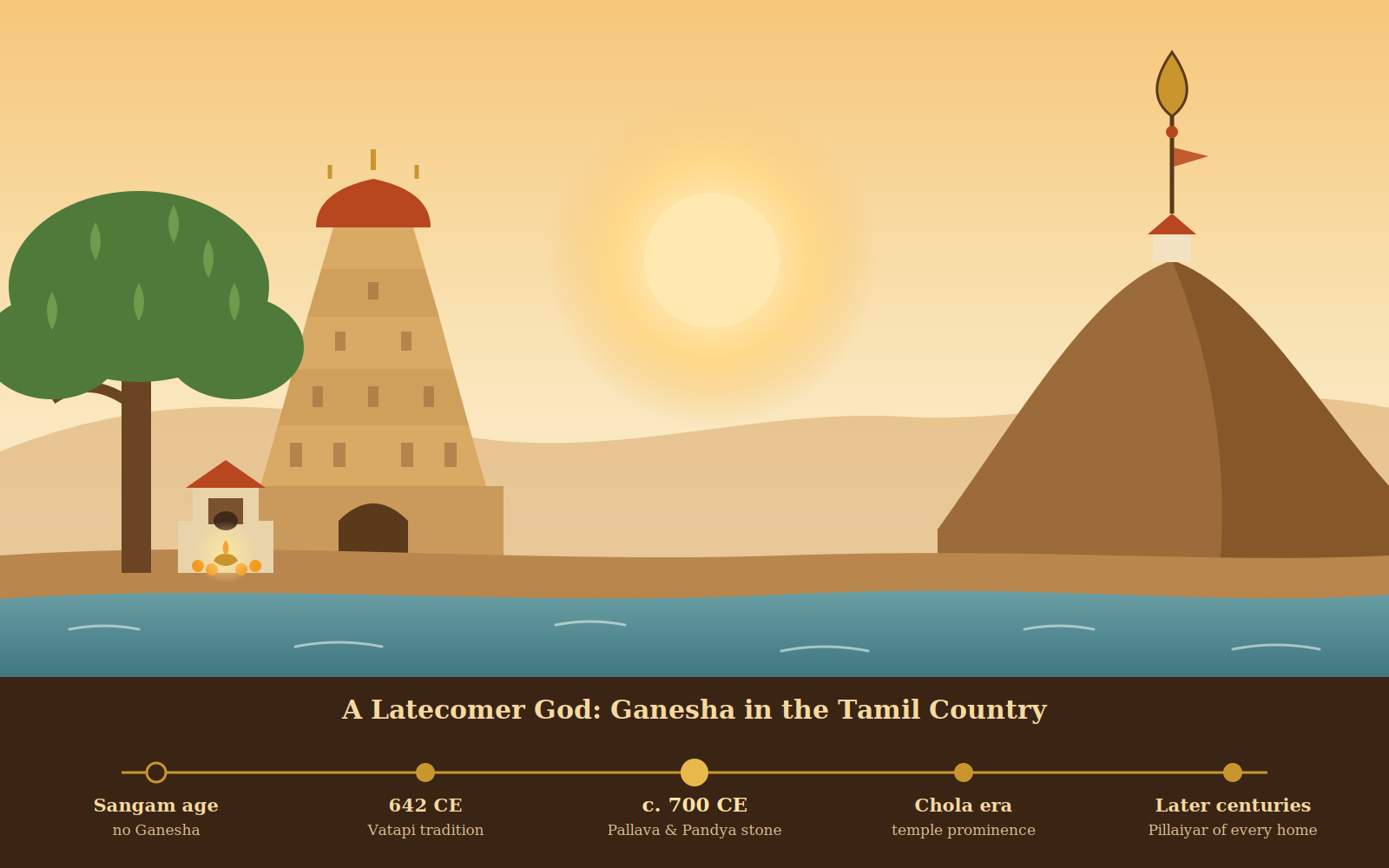
1. The silence of the early Tamil record The oldest body of Tamil literature, the Sangam anthologies (roughly 300 BCE to 300 CE), describes a rich religious landscape. It names Murugan (Seyon) of the hills, Mayon (Tirumal) of the pastures, Ventan of the fertile plains, and Korravai, the goddess of war and the wilderness. It describes ecstatic rites, possession dances, offerings and hero stones.
There is no elephant-headed god in any of it.
The silence continues in the great works that followed. The Silappatikaram does not mention Ganesha, despite its detailed portrait of temples and festivals in the cities of the Tamil kingdoms. Nor does the Tirumurugarruppadai, a devotional poem dedicated to Murugan, who would later be described as Ganesha's brother. For a figure who now stands at the start of every Tamil ritual, this absence is striking. It tells us that for the first several centuries of recorded Tamil religion, Ganesha simply was not part of the picture.
2. Where Ganesha came from
Ganesha did not originate in the Tamil country, nor in Maharashtra, as is sometimes claimed. He is not a Vedic god either. The four Vedas contain no elephant-headed deity. A verse of the Rigveda (2.23.1) is often recited today in Ganesha worship because it uses the word Ganapati, "lord of the hosts." In its original context, however, it addresses Brahmanaspati, a Vedic god of prayer, not Ganesha. Its use for Ganesha is a later reinterpretation.
The earliest traces of an elephant-headed divine figure come from northern India, in texts that are post-Vedic appendices to the ritual tradition. Domestic ritual manuals such as the Manava Grihya Sutra, describe troublesome spirits called vinayakas who cause obstacles and must be appeased. Over time, these obstacle-makers merged into a single god who both creates and removes obstacles.
The recognizable image of Ganesha, pot-bellied, elephant-headed, holding a sweet, takes shape in sculpture during the Gupta period (around the 4th to 6th centuries CE) in northern and central India. From there, his worship moved south through the Deccan, where the Chalukyas of Badami were ruling in the 6th and 7th centuries. Marathi as a written language and Maratha political identity came much later: Marathi inscriptions appear around the 11th century, and the Maratha state only emerged in the 17th. The Maharashtrian devotion to Ganapati is real and deep, but it is a later regional flowering, not the source of the god.
3. The turning point: the 7th century The Tamil story of Ganesha begins in earnest in the 600s, in a period of intense conflict and contact between the Pallavas of Kanchipuram and the Chalukyas of Badami. The Vatapi tradition In 642 CE, the Pallava king Narasimhavarman I defeated the Chalukya king Pulakeshin II and sacked his capital, Vatapi (modern Badami, in Karnataka). His general was Paranjothi, who is traditionally identified with the Shaiva saint Siruthondar, one of the sixty-three Nayanmars. According to Tamil tradition, Paranjothi brought back a Ganapati image from Vatapi and installed it at Tiruchengattankudi, where a shrine to Vatapi Ganapati still exists. Centuries later, the famous Carnatic composition Vatapi Ganapatim Bhaje would keep the name alive. Historians treat this story with caution. It comes largely from later tradition, and it is unlikely that a single captured image launched an entire cult. But it preserves something historically plausible: Tamil memory itself links Ganesha's arrival to the Deccan and to the Pallava–Chalukya wars of the 7th century.
The first Tamil hymns
In the same century, the Shaiva poet Tirugnana Sambandar composed a hymn at Tiruvalivalam that mentions Ganapati, describing him as born to Shiva and Uma to remove the obstacles of devotees.
What stands out is how rare such references are. Across the entire Tevaram of Appar, Sambandar and Sundarar, thousands of verses, Ganesha appears only in a handful of passages. The Nayanmar poets sang overwhelmingly of Shiva, of Uma, and of Murugan. Ganesha was known to them, but he was a minor figure at the edges of their devotion.
4. Around 700: Ganesha enters stone Texts can be lost, edited or added to. Stone is harder to rewrite. And it is in stone that the rise of Ganesha around 700 becomes clearest. Pallava temples. Under Narasimhavarman II (Rajasimha, c. 690–728), the Pallavas built the Kailasanathar temple at Kanchipuram, a structural temple covered in divine figures. Ganesha appears among the sculpted deities of Pallava art in this period, typically as a secondary figure within a Shaiva programme rather than as the focus of worship. Rock-cut caves of the south. In the Pandya territories, rock-cut cave shrines of roughly the 7th and 8th centuries frequently include a Ganesha panel, often placed alongside Shiva or near the Seven Mothers (Saptamatrikas). The rock-cut image at Pillaiyarpatti, near Karaikudi, is among the best known. Its date is debated, with estimates ranging over several centuries, but it belongs to this broad early phase of rock-cut worship in the Tamil south. A warning against over-reading. Not everything labelled "ancient Ganesha" is what it seems. The so-called Ganesha Ratha at Mamallapuram was built by the Pallavas as a shrine to Shiva, as its own inscription indicates. Its association with Ganesha came later. Such cases are a useful reminder that the prominence of Ganesha in Tamil religion has sometimes been projected backwards onto older monuments.
Taken together, the evidence from around 700 shows a god who has arrived, who is being carved into temples and caves, and who is gaining a place in the Shaiva world, but who is still a companion figure rather than a central one.
5. What drove the cult Ganesha's rise in this period was not an accident. Several forces worked together. Royal patronage. Pallava and Pandya kings built temples on a new scale, and temple construction required a full divine family around Shiva. Ganesha fitted naturally into this expanding pantheon.
Contact with the Deccan. Wars, alliances and the movement of artisans between the Pallava and Chalukya realms carried iconographic models southwards. The sculptural style of early Tamil Ganesha images shows these northern and Deccan connections. Agamic and Sanskritic temple religion. The spread of Agamic ritual, which prescribed the order of worship in temples, gave Ganesha a defined function: he is worshipped first, as the remover of obstacles, before any rite begins. This ritual role, more than any story, made him indispensable. Brahmin settlement. Pallava kings granted land to Brahmin communities and supported Sanskrit learning at Kanchi. Some of these communities came from outside the Tamil country. They brought with them the pan-Indian Puranic mythology in which Ganesha was already established. It is important not to overstate this last point. There is no inscription or text showing a single group of imported priests "introducing" Ganesha, and nothing links the process to Marathis, who did not exist as a community at the time. The spread was gradual, carried by kings, temple builders, artisans, ritual manuals and poets together. 6. After 700: from companion to Pillaiyar
The full Tamil embrace of Ganesha came later, largely from the Chola period onward. Under the Cholas (9th to 13th centuries), Ganesha became a fixed part of Shaiva temple layouts, and Chola-era bronzes of him survive in large numbers. The compilers of the Shaiva canon, the Tirumurai, included hymns dedicated specifically to him, by Kapila Devar and by Nambiyandar Nambi, the scholar credited with recovering the Tevaram under Raja Raja Chola.
In later centuries came the Vinayagar Agaval, attributed to a later poet known as Avvaiyar, which is still widely recited, and, in the 18th century, Kachiyappa Munivar's Tamil Vinayaga Puranam.
Most importantly, Tamils made the god their own. They called him Pillaiyar, "the noble child." They placed him under trees and beside water, often with no priest at all. The roadside Pillaiyar, worshipped with a coconut, a flower and a whispered prayer, is as Tamil as any temple ritual, and far older in spirit than the complex Agamic worship that first carried Ganesha south.
7. "Remover of obstacles": a title, not a monopoly This article is not a call for Tamils to stop praying to Pillaiyar. He has been part of Tamil devotion for more than a thousand years, and that devotion is sincere. But history invites us to question one idea that is repeated so often it seems self-evident: that Ganesha alone is the remover of obstacles, and that nothing can begin without him. That role has a history. The earliest vinayakas were not removers of obstacles at all. They were spirits who caused them and had to be appeased. The idea that Ganesha must be worshipped first, before every rite, became fixed through Agamic temple ritual, the same system that carried him into the Tamil country. It is a ritual rule, not an ancient Tamil belief. Long before that rule took hold, and alongside it, Tamil saints turned to Shiva and Murugan to free them from distress, fear and misfortune. The Tamil word they used was idar (இடர்): affliction, trouble, obstacle. In Tamil devotion, every god who is truly loved removes idar.
Appar, 7th century
According to tradition, Appar sang these lines when the Pallava king summoned him to court to punish him for leaving Jainism. Relying on Shiva alone, he refused to be afraid: நாமார்க்கும் குடியல்லோம் நமனை அஞ்சோம் நரகத்தில் இடர்ப்படோம் நடலை இல்லோம் ஏமாப்போம் பிணியறியோம் பணிவோம் அல்லோம் இன்பமே எந்நாளும் துன்பம் இல்லை
Naamaarkkum kudiyallom, namanai anjom; narakaththil idarppadom, nadalai illom; emaappom, piniyariyom, panivom allom; inbame ennaalum, thunbam illai.
We are subject to no one; we do not fear Death; we shall suffer no affliction in hell; we know no misery; we rejoice, we know no sickness, we bow to no one; joy is ours every day, and sorrow there is none.
Sambandar, 7th century: the Kolaru Pathigam Sambandar's hymn is still recited by Tamils who fear the influence of the planets. Its message is that Shiva dwelling in the heart makes every misfortune harmless: வேயுறு தோளிபங்கன் விடமுண்ட கண்டன் மிகநல்ல வீணை தடவி மாசறு திங்கள் கங்கை முடிமேல் அணிந்தென் உளமே புகுந்த அதனால் ஞாயிறு திங்கள் செவ்வாய் புதன் வியாழம் வெள்ளி சனி பாம்பிரண்டும் உடனே ஆசறு நல்லநல்ல அவைநல்லநல்ல அடியாரவர்க்கு மிகவே
Veyuru tholi pangan, vidamunda kandan, mikanalla veenai thadavi, maasaru thingal gangai mudimel anindhu, en ulame pugundha adhanaal, gnaayiru thingal sevvaai budhan viyaazham velli sani paambirandum udane aasaru nallanalla, avai nallanalla, adiyaar avarkku migave.
The one who shares his body with Uma, whose shoulders are graceful as bamboo, whose throat holds the poison he swallowed, who plays the sweet vina, who wears the spotless moon and the Ganga on his head, has entered my heart. And so the Sun, the Moon, Mars, Mercury, Jupiter, Venus, Saturn and the two serpent planets are all good, truly good, free of harm, to those who serve him.
The Kanda Shasti Kavacham: Murugan who removes idar This hymn to Murugan, attributed to Devaraya Swamigal in the 19th century, is sung in Tamil homes and temples from Tamil Nadu to Mauritius. Its opening verses present Murugan himself as the god who ends distress: துதிப்போர்க்கு வல்வினைபோம் துன்பம்போம் நெஞ்சில் பதிப்போர்க்குச் செல்வம் பலித்துக் கதித்தோங்கும்
Thudhippoarkku valvinai poam, thunbam poam; nenjil padhippoarkku selvam paliththu kadhiththongum.
For those who praise him, heavy karma departs and sorrow departs; for those who hold him in their heart, prosperity flourishes and grows.
அமரர் இடர்தீர அமரம் புரிந்த குமரன் அடி நெஞ்சே குறி
Amarar idar theera amaram purindha Kumaran adi, nenje, kuri.
O heart, fix yourself on the feet of Kumaran, who went to war to remove the distress of the gods.
The lesson is simple. Pray to Pillaiyar if he is dear to you. But do not believe that the path to God is blocked until he is honoured first, or that obstacles fall away only in his name. The Tamil saints called on Shiva and on Murugan in their hour of trouble, and they were heard. 8. Conclusion The historical record supports a clear and defensible picture: • Ganesha is absent from the Vedas and from early Tamil literature, including the Sangam corpus and the Silappatikaram. • He enters the Tamil world in the 7th century, through Pallava contact with the Deccan, remembered in the Vatapi tradition and noted briefly by Sambandar. • Around 700 CE, he appears in Pallava and Pandya temples and caves, driven by royal temple-building, Agamic ritual and Sanskritic learning, but still as a secondary figure. • He becomes central only later, under the Cholas and in the medieval Tamil devotional literature that followed. The Ganesha cult in the Tamil country, then, is neither primordial nor imposed overnight by a single group. It is the story of an outside god who arrived late, was carried in by kings and temples, and was slowly transformed by ordinary Tamils into Pillaiyar, the most familiar and approachable deity of the Tamil home. Knowing this history need not weaken anyone's devotion. It simply frees it. Pillaiyar can be honoured with love, while remembering that the Tamil saints never needed a single gatekeeper god: for them, Shiva, Uma and Murugan were always close enough to remove every idar.
Further reading • R. Champakalakshmi, Religion, Tradition, and Ideology: Pre-colonial South India • Indira Viswanathan Peterson, Poems to Siva: The Hymns of the Tamil Saints • Kamil V. Zvelebil, Tamil Literature and The Smile of Murugan • Paul B. Courtright, Ganesa: Lord of Obstacles, Lord of Beginnings • Robert L. Brown (ed.), Ganesh: Studies of an Asian God Note: Several dates in this field remain debated, particularly for rock-cut images such as Pillaiyarpatti and for traditions like the Vatapi story. Readers citing this article should check the specialist sources above for the latest scholarship.
Published 15 September 2026 · www.mauritiustamil.com