# We Are the Venue, Not the Beneficiary
### Some honest questions before the 13th World Tamils Economic Conference opens in Réduit
✎ Mauritius Tamil◷ 10 September 2026
# We Are the Venue, Not the Beneficiary
### Some honest questions before the 13th World Tamils Economic Conference opens in Réduit
---
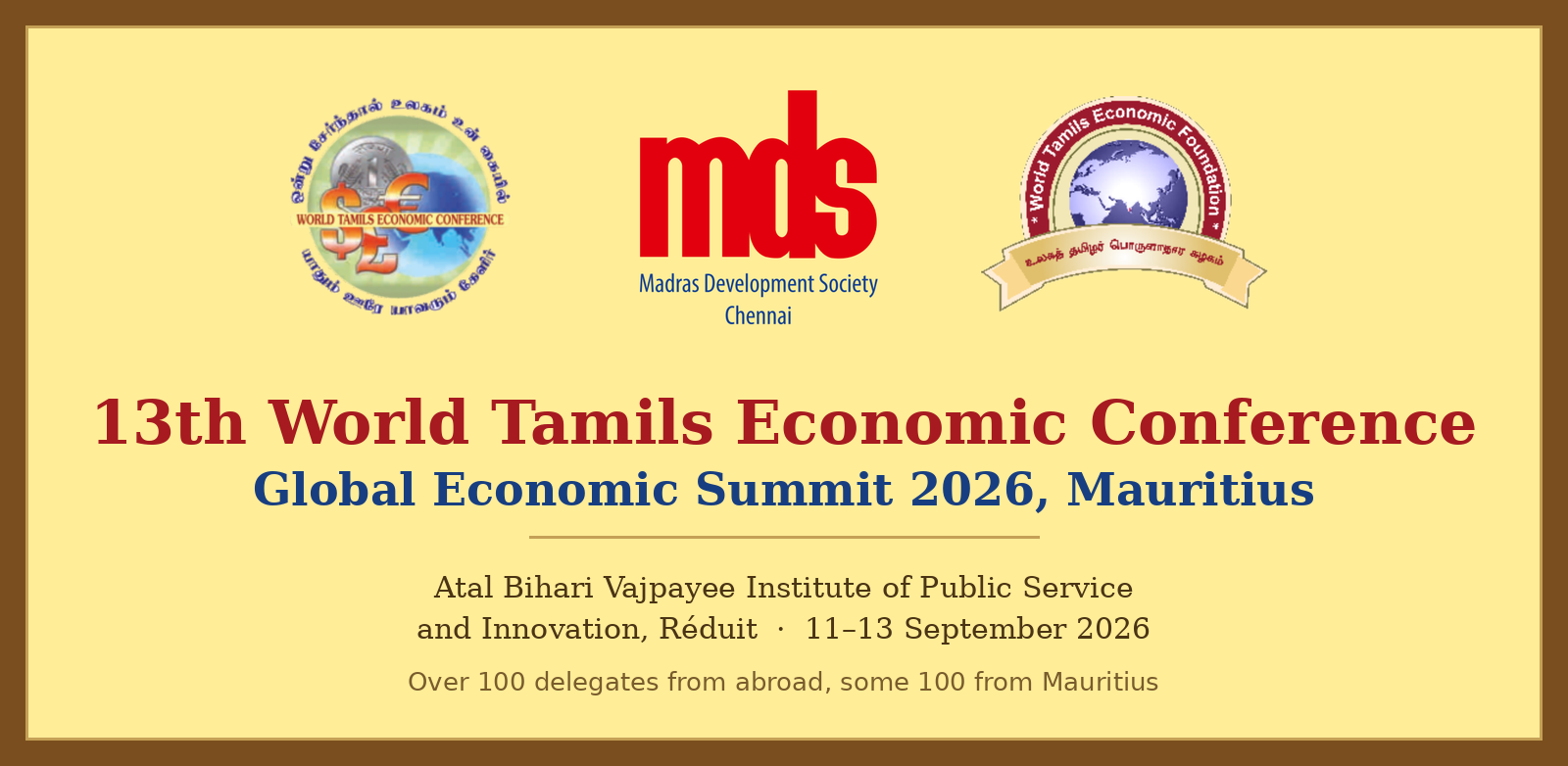
From 11 to 13 September, the 13th World Tamils Economic Conference and Global Economic Summit will be held at the auditorium of the Atal Bihari Vajpayee Institute of Public Service and Innovation. The Prime Minister will inaugurate it and deliver the keynote address. The President will give the valedictory address and present awards. India's High Commissioner attends as chief guest. Delegates from more than twenty countries are expected.
By any protocol measure, this is a significant event, and the Mauritian Tamil community will be told repeatedly over three days that it is being honoured.
Before we accept the compliment, a few questions are worth asking out loud.
## The question nobody asks about conferences
This is the thirteenth edition. There have been twelve before it, going back to Chennai in 2009, passing through Dubai, Durban, Puducherry, Kuala Lumpur and Washington DC.
So: what did the previous twelve produce?
Not how many people attended. Not who was garlanded. What commercial outcome followed. How many joint ventures were signed and are still trading. What was the value of trade generated. Which company exists today that would not exist without the Durban conference of 2017.
This is not a hostile question. It is the ordinary question that any funder, any board, any serious institution asks of a recurring programme. If the organisers can answer it, the answer will settle the argument in their favour immediately and this article will have been wrong. If nobody can answer it, that silence is itself the finding.
The burden of proof here does not sit with us. It sits with an organisation asking Mauritians to pay MUR 9,000 for an individual seat, MUR 67,500 for a "Business Leader" place, and considerably more for institutional participation.
## Read the pitch carefully
The stated purpose of the summit is to position Mauritius as an investment destination and a gateway to African markets, while highlighting business and industrial opportunities in Tamil Nadu and Puducherry.
Read that sentence again slowly, because it describes the direction of travel with complete honesty.
An Indian delegate arrives with something to sell and somewhere to look. He is prospecting for an African foothold and advertising opportunities back home. In that transaction, Mauritius is the location and the Mauritian Tamil community is the welcoming host, the cultural programme, the audience, and the reason the Prime Minister showed up.
Being the venue is not nothing. It is also not a benefit.
And let us be clear about something, because a certain kind of grievance is going around and it deserves to be answered directly: there is nothing improper about a Chennai organisation running an event that serves Chennai interests. That is what organisations do. Nobody, anywhere, convenes a summit for the primary purpose of enriching somebody else's community. The error is not theirs. The error is ours, if we turn up expecting generosity instead of turning up with something to trade.
## The awards
Two categories will be conferred: Crown Jewel of World Tamils, and Crown Jewel of Business Leaders.
There is no published nomination process. No jury. No criteria. No shortlist. The "Business Leader" registration tier, at MUR 67,500, lists "recognition during the conference" among the things it buys, alongside priority seating and lunch.
Readers can draw their own conclusion about what is being sold. What should be said plainly is that a decoration handed out under these conditions carries exactly the weight of the process behind it, and here the process is not visible. Anyone tempted to add such a title to a letterhead should consider how it will read to a banker who looks it up.
*(A smaller point, but telling. As of the first week of September, the official conference website still carried unedited template content: placeholder "testimonials" in Latin filler text, stock-photograph "speakers" with invented European names, a venue map pointing at the London Eye, and attendance counters reading zero. This may be corrected by the time you read this. It should not have been true two weeks before a summit inaugurated by a head of government.)*
## The harder conversation
All of that is the easy criticism. Here is the difficult part, and it is about us.
Suppose the conference were superb. Suppose the delegates were serious, the sessions substantive, the contacts golden. Would the Mauritian Tamil community be positioned to convert any of it?
The honest answer is no, and the reason is historical.
The Mauritian historian Sadasivam Reddi, in his study of the Tamil merchant class, records something we do not discuss enough: a Tamil merchant class no longer exists in Mauritius. In the nineteenth century it plainly did. Chettiar and Vellala merchants held commercial property in Port Louis and Rose Hill, held sections of the Central Market, owned ships, and in some cases acquired sugar estates. They built our great temples. They funded our first schools and our first newspaper.
Three things ended it. From the 1870s they were displaced from their commercial position by Gujarati Muslim and Chinese merchants. Many were never rooted here in the first place, moving constantly between Mauritius, Réunion, Seychelles, South Africa and India, and never settled. And the third, which matters most, was not a defeat at all: the merchant families who left trade in the 1920s and 1930s sent their children into the liberal professions and the bureaucracy. Neither their clerks nor the wider Tamil community around them inherited the trading activities. Marriage alliances with the rising rural elite of teachers and clerks completed the shift, producing a community elite that was overwhelmingly professional and bureaucratic.
That was a rational bet. For two generations it paid handsomely. It gave us doctors, lawyers, magistrates, headmasters, senior civil servants, and a political voice far larger than six per cent of the population would suggest.
But it also means that what we lack today is not education, ambition, or intelligence. It is the specific inheritance that only passes down inside families that trade: collateral, banking relationships built over decades, suppliers who extend credit on a name, the financial cushion to survive a bad year, and children who grow up watching a business run and absorb how it works without ever being taught.
Contacts are not our binding constraint. Contacts are the cheapest thing an entrepreneur can acquire. Capital, collateral and inherited commercial instinct are the expensive things, and no three-day summit has ever supplied them.
## What would actually work
If this community is serious about rebuilding a commercial base, the instruments are known and none of them is glamorous.
A mutual guarantee fund or credit cooperative, so that a young Tamil Mauritian with a viable plan and no collateral can borrow against a collective rather than against a house he does not own.
The property held by our temples and socio-cultural associations, which is substantial and largely idle, put to work as a balance sheet instead of standing as ceremonial real estate.
Structured apprenticeships placing our young people inside working diaspora firms in Chennai, Durban or Kuala Lumpur for two or three years, because commercial know-how transmits through employment, not through panels.
Each of these takes ten years and a committee that keeps meeting long after the photographs have been filed. None of them produces a stage, a garland, or a citation to frame.
## Go, but go as a buyer
None of this is an argument for staying home. Go, if you have something to sell or something specific to look for. Three days of contact with Chennai buyers may be worth MUR 9,000 to an exporter, a lawyer or a software firm. That is a straightforward commercial calculation and each person can make it.
What is not worth MUR 67,500 is the feeling of importance.
And when the speeches are over, the community should ask its own leadership one question. If the same energy that went into securing this conference, filling the hall and arranging the protocol had instead gone into establishing a Tamil mutual credit fund, where would we be in ten years?
The ceremony is available on Friday. The substance takes a generation. The great danger is not that this conference is a fraud. It is that it is pleasant enough that we mistake attending it for doing something.
---
*The author welcomes correction. If the organisers of the World Tamils Economic Foundation can document commercial outcomes from previous editions, this publication will print them in full.*
Published 10 September 2026 · www.mauritiustamil.com